Sunday 22nd January 1978
It was the final night shift of a long week, and I paraded for duty at Bishopsworth Police Station at 21:45, ready for the 10pm to 6am tour. A cold, damp night ahead—but with two rest days in sight, morale was holding.
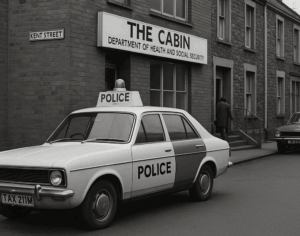
That night, I was crewed with PC726 Mike Ward, our divisional motorcyclist, who was usually seen darting around on his 250cc Honda Superdream. But the icy roads had grounded the bike, so we were allocated a marked Hillman Avenger panda car—distinctive with its single blue light and glowing roof sign.
In those days, the B Division Control Room operated from the first floor of Broadbury Road Police Station. Staffed by officers who knew the patch inside out, it gave us a level of local insight that’s hard to replicate. That all changed when the control room was relocated to Portishead HQ, run by civilian personnel unfamiliar with the beats we knew like the back of our hands.
Mike and I were assigned to cover Bedminster and Ashton—Areas B1 and B9. With refreshments not until 2am, we set out into the night, patrolling the quiet, slippery streets and looking for anything suspicious.
While driving along Highbury Road in Bedminster, we found ourselves behind a Ford Cortina, registration ATK 916B. Its offside rear light wasn’t working. I suggested we stop the driver and offer a bit of advice. I was still in my probationary period then, two years to prove myself, and every incident mattered. But I also remembered the words of my tutor, PC Peter Ephgrave: minor offences sometimes just need advice—it builds community trust. That is, unless they fail “the attitude test.”
As we pulled the Cortina over, the driver was out of the car before I reached him—agitated and shouting.
“What are you stopping me for? You should be catching burglars and rapists!”
Not the best start.
I introduced myself and calmly explained the rear light issue. But he wasn’t having it. He kept going on about how we had better things to do. His name, he said, was Royston Adams, born 09/12/1954. He was unemployed and living on Coronation Road in Bedminster.
We ran a check on the car. It wasn’t reported stolen, but DVLA showed it had recently changed hands. Adams claimed he had just bought it. The tax disc was valid until the end of January.
When I asked to see his driving licence, he surprised me by producing it—a green paper provisional. I pointed out that he should have L-plates and a qualified driver with him.
“I know,” he said flatly.
Well, that changed things. I explained he would be reported for three offences: driving without L-plates, unauthorised driving, and driving without insurance. I cautioned him. He said nothing.
Since there were no mobile phones in those days, I told him he’d have to find someone to collect the car. He said he was already on his way to a friend’s house and walked off into the cold night.
Our shift continued, and we clocked off at 6am.
But the case stuck with me. I still needed to complete the paperwork, so on Sunday the following Sunday when I was working the late shift, I headed to the South West Criminal Registry Office in New Bridewell, Bristol. Which was then Avon & Somerset HQ.
What I discovered changed everything.
Royston Adams was a disqualified driver—banned until September 1978.
That elevated the seriousness of the offence. He was now arrestable. I needed to find him.
On Wednesday 8th February, I was on early shift and knocked on his Coronation Road door at 8:10am. No answer—possibly spooked by the marked police car outside.
Later that week, Sgt Frank Garfitt, never one to let things slide (and always on my back, though I’d later appreciate why), insisted I deal with it.
At 9:45pm on Thursday 23rd February, he drove me to Adams’ address. Sgt Garfitt’s knock nearly took the door off its hinges. An older man—mid-50s, heavyset—answered and said Royston wasn’t in; he was his father.
Sgt Garfitt didn’t mince words. He told Mr Adams that his son needed to attend Bishopsworth Police Station after 6pm the following evening. Firm, clear, and unmistakable.
To my surprise, Royston Adams turned up at 6:30pm the next day.
“You know why you’re here tonight?” I asked.
“Yes,” he replied.
I asked why he hadn’t mentioned being disqualified when we first stopped him.
“I didn’t think I was,” he said. “I went to court a few weeks ago, got fined and some endorsements, but I didn’t think I was banned.”
I told him he was being reported for driving while disqualified and cautioned him.
He told me he’d got rid of the car the day after the stop. Said he was just heading home that night. He’d only had the car four weeks and admitted it wasn’t in great shape.
I asked if he wanted to make a statement under caution.
“No,” he said. “It’s not worth it. I was driving and that’s that.”
I completed the paperwork to summon Adams to court. Sgt Garfitt was satisfied with my handling of the case—for once.
Reflections:
Looking back, it was a routine stop that turned into something more serious. It taught me early on the importance of thorough follow-up and trusting instincts. And, of course, the value of a well-timed knock from a no-nonsense sergeant.nuine connections along the way.